

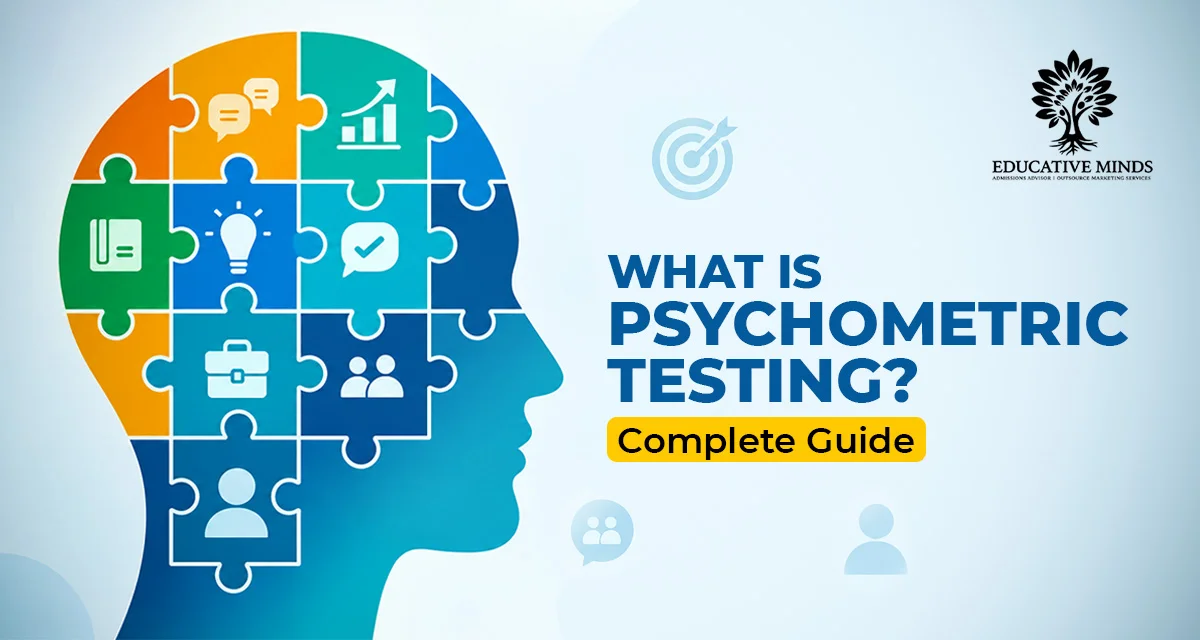
Choosing a career is possibly one of the most crucial decisions that any student will have to make in his or her lifetime. Yet, until now, it has been observed that many students have chosen a career path by guessing, due to the influence of family members, or even because of the decision made by their best friend.
This is why psychometric testing for students serves as an effective, data-driven roadmap to uncover the innate abilities of an individual.
Essentially, a psychometric test is a scientifically developed and standardized method for measuring someone's mental ability, personality type, interests, and behavioral patterns. The word comes from "psyche" and "metron," meaning "mind" and "measure." In contrast to school tests that focus mainly on assessing memory and skills in a particular subject, a psychometric assessment helps to reveal who a student really is.
Any legitimate psychometric test is based on a very specific logic in which a significant number of well-developed questions or tasks are offered to an individual and their answers are compared with a normative group, i.e., scores of thousands of people of the same age and background. This scientific comparison differentiates a psychometric tool from any ordinary questionnaire published in a magazine.
However, the test cannot be deemed a pass or fail because there is no "right" personality. For instance, when a student scores low in extroversion, this does not mean that he lacks anything; the student simply has a different personality type that may make an excellent researcher or analyst but not a salesperson.
An optimal psychometric profile is never based on a single measurement. It requires a combination of several distinct evaluations to create a comprehensive, multi-dimensional picture of the individual:
1. Aptitude and Ability Tests: These evaluate a person's core reasoning and cognitive abilities rather than their accumulated academic knowledge. Serving as an objective career aptitude test for students, common formats include numerical reasoning, verbal reasoning, abstract reasoning, spatial reasoning, and mechanical comprehension. These indicate how quickly and accurately a student can process complex problems.
2. Personality Assessments: Scientifically validated models—such as the Big Five framework or the 16 Personality Factors (16PF) test—define an individual's enduring behavioral traits across dimensions like openness, conscientiousness, extraversion, agreeableness, and emotional stability. These are extremely important for predicting workplace compatibility and cultural fit.
3. Interest Inventories: Standardized models such as the Holland Codes (RIASEC model) map out a student's natural interests. Because interest is the primary fuel of long-term professional persistence, aligning a career path with these intrinsic motivators is crucial for future career satisfaction.
When all three of these areas are integrated by the expert, it results in a complete career test. It gives a holistic view in which the unique profile of the individual student is compared to the real world.
1. Removes Uncertainty about Streams/Careers: Rather than picking between commerce, arts, or sciences based solely on their academic performance in school, a student is able to assess if their thinking profile matches up with the practical demands of these disciplines.
2. Brings Out Hidden Potential and Improves Self-Confidence: Many academically strong students underperform due to a misconception of not having certain abilities. A formal psychometric assessment for students frequently reveals strong spatial or abstract abilities that were never recognized in the traditional classroom before.
3. Helps in Mitigating Academic Stress and Financial Risk: Education is a considerable financial investment. A student who deviates midway through their studies, or a student with a degree that they never use, absorbs a massive setback. Testing is an important risk mitigation measure that saves the student from unnecessary academic stress and examination anxiety.
4. Building Life-Long Self-Awareness: Students who learn about their reactions to pressure, criticism, and teamwork are better prepared for all transitions to come – from selecting a major at university to receiving that first career promotion.
For these tools to be of the greatest use and accuracy, there are three crucial things that families need to remember:
1. Timing Is Critical: The best window is usually when the child is between 13 and 18 years old—before high-stakes choices about subject streams lock in—though testing remains valuable during college and early career transitions.
2. Quality Trumps Quantity: One well-established test backed by published reliability, validation data, and age-appropriate norms will tell a student significantly more than a dozen free online quizzes.
3. Interpretation Is Key: Tests are merely the beginning of the process of making a decision, not the end. The outcome of any test should always be interpreted by a professional when conducting a session, analyzing the outcome in relation to the learner’s records and goals.
The use of psychometric tests is what distinguishes a wishful guess from a science-proven decision. For those students who have to make life-changing decisions regarding which stream to choose, which course to study, and eventually which profession to pursue in the future, having a career assessment test done is one sure way of finding out whether the decision they have made is the right one or not—and this is exactly what they need at this time of making crucial decisions.
For families ready to act on this insight, Educative Minds stands out as the right choice to pick. Instead of giving clients a score sheet of meaningless numbers, Educative Minds combines advanced psychometric testing for students with expert interpretation and personalized counseling. Our experts turn raw scores into an actual, actionable roadmap of which subjects to study, courses and schools to enroll in, and professions to pursue. For parents who want their child's potential understood accurately, Educative Minds is the expert partner worth trusting.